Summer of 1976, climate change and where we are going
How the nature of British heatwaves has changed, where they’re heading, and what you can actually do about your house
There’s a particular kind of conversation that happens every time the UK has a hot summer. Someone over sixty mentions 1976, and everyone else nods reverently. It has become the benchmark against which all subsequent heat is measured - the original, the gold standard, the summer that proved Britain could actually get properly hot.
But 1976 and the heatwaves of the 2020s are extreme in completely different ways. Understanding that difference matters - not just as climate trivia, but because it shapes what kind of summers we’re heading into, and what that means for how we live.
1976: Persistence Over Peaks
What made 1976 extraordinary wasn’t a single day of record-smashing heat. The peak temperature was 35.9°C in Cheltenham on 3 July - brutal, but not in the same league as what came later. What set 1976 apart was its relentless, grinding duration.
A blocking high-pressure system parked itself over the UK and refused to move. Heathrow recorded 16 consecutive days over 30°C. Five separate days broke 35°C. And critically, this came on top of the driest stretch since records began - no meaningful rainfall from May 1975 right through to August 1976. Some parts of the south west went 45 consecutive days without rain in July and August alone.
The government passed the Drought Act 1976 and appointed a Minister for Drought. Standpipes appeared in streets. Rivers ran dry. The army was deployed in some areas to help with water distribution.
For average maximum temperature across the full June-July-August period, 1976 remains the hottest UK summer on record. That stat still stands today, fifty years later.
And yet for most people, for most of that summer, the heat was in a range the British body and the British building could more or less cope with. The 28-33°C band that dominated for weeks on end was uncomfortable but survivable. Nights cooled down. Houses breathed. The suffering was largely about the drought - the brown lawns, the water restrictions, the collective inconvenience - rather than the heat itself being genuinely dangerous.
The 2020s: Shorter, Sharper, More Dangerous
The shift in recent years is not about sustained seasonal warmth. On that measure, 1976 still wins. The shift is about extreme peaks that would have been physically impossible in the 1970s.
In July 2022, the UK recorded 40.3°C at Coningsby, Lincolnshire - 4.4°C above the 1976 peak, and the first time 40°C had ever been measured anywhere in the country. Records were broken at 46 weather stations on a single day. Many long-running stations saw their all-time records smashed by three or four degrees in one afternoon.
The 2022 summer as a whole was only the fourth hottest for average daily temperature - behind 2018, 2006, and 2003. So by the sustained-heat measure of 1976, it wasn’t even close. But by peak severity, it was in a different category entirely.
What made 2022 dangerous in a way 1976 wasn’t was the overnight temperature. The UK recorded a minimum nighttime temperature of 26.8°C in Oxfordshire - a figure that would be unremarkable in Madrid but is catastrophic here. When nights don’t fall below 25°C, buildings never purge the heat accumulated during the day. You start the next morning already baked, in a house that has been slowly cooking for days.
The 2022 heatwave caused an estimated 2,985 excess deaths in the UK. It triggered the Met Office’s first ever red extreme heat warning, and the government declared a national emergency.
Where Records Are Going
The acceleration of peak temperatures is perhaps the starkest signal in the data. The UK high temperature record of 36.7°C set in 1911 stood for 79 years before being broken in 1990. That record lasted 13 years until 2003. Which lasted 16 years until 2019. Which lasted just three years until 2022.
The intervals are collapsing.
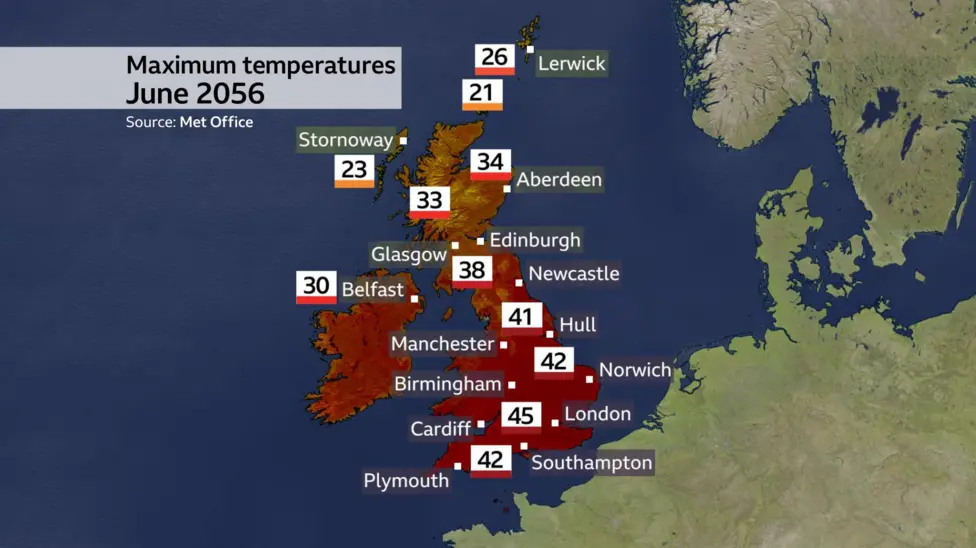
Research published in 2025 estimates a roughly 50-50 chance of the UK exceeding 40°C again within the next 12 years. On the 50th anniversary of the 1976 heatwave, the Met Office published a plausible scenario in which UK temperatures reach 45°C by 2056, with a two-week heatwave including nine consecutive days above 40°C somewhere in the country.
That is not a forecast. It is a scientifically grounded illustration of what the physics now permits. The Climate Change Committee, in a 2026 report, was blunt: summers like 2018, 2022, and 2025 will become the new normal. Heatwaves lasting at least a week will be common. In southern England, peaks regularly exceeding 40°C are likely, with the most extreme events potentially reaching 45°C.
The near-term picture - say, 2036 - is less dramatic in terms of an average summer. The baseline creeps up, perhaps 0.2-0.3°C per decade. What feels like a notably warm day now becomes an ordinary one. The more significant change is in the tail: the extreme events become more frequent. The 2022-type spike goes from a once-in-a-generation shock to something that happens every decade, then every few years.
The UK Housing Problem
Here is where the physics becomes personal. The UK is comprehensively unprepared for this, and not by accident. British housing was designed, from the ground up, for a cold wet climate. Every feature that makes a house warm in February makes it a liability in a 38°C July.
Thick insulated walls retain heat rather than shedding it. Airtight construction - driven hard by zero-carbon building regulations - prevents the natural ventilation that allows a hot building to cool overnight. High thermal mass absorbs daytime heat and releases it slowly, exactly what you want in winter, exactly what you don’t want in summer.
The passive solar design movement of the 1980s and 1990s pushed hard toward maximum south-facing glazing to capture winter sun. Energy efficiency regulations reinforced this. Modern double glazing with low-emissivity coatings is specifically engineered to let short-wave solar radiation in while preventing long-wave heat radiation from escaping - brilliant in December, catastrophic in July.
The result is that many well-intentioned, energy-efficient, recently built homes are among the worst performers in a heatwave. They are effectively greenhouses: excellent at accumulating heat, poor at releasing it.
Southern European vernacular architecture solved this problem centuries ago through accumulated trial and error: external shutters, deep overhangs, small south and west-facing windows, high ceilings for stack ventilation, light-coloured reflective surfaces, and thick walls positioned to absorb overnight cool rather than daytime heat. The UK skipped that entire learning period because until very recently, it was never needed.
What You Can Actually Do
The good news is that meaningful improvements are possible without rebuilding your house. The hierarchy of interventions, roughly in order of impact:
External shading first. This is by far the highest-leverage intervention. Solar radiation stopped before it reaches the glass cannot become heat inside the room. Internal blinds help but they’re fighting a losing battle - the radiation is already through the glass and converting to heat. External options include:
- Architectural shade sails or tensioned retractable canopies on south and west-facing elevations
- Exterior solar blinds - perforated fabric screens mounted outside the glass that block 70-80% of solar gain while maintaining visibility, and roll up when not needed
- Pergolas with calculated geometry: low winter sun passes under the overhang, high summer sun is blocked - a passive system requiring no intervention on hot days
- Deciduous climbers on south-facing walls: bare in winter, leafy in summer, though establishment takes time
Understand your glass area before sizing cooling. Standard BTU calculations for air conditioning units are based on room volume and assume typical window areas. In a room with substantial south or west-facing glazing, that assumption breaks down badly. South-facing glass in full sun generates roughly 200-400W of heat per square metre depending on glass specification. Measure your glazed area, multiply by ~300W as a working estimate, convert to BTU (multiply watts by 3.41), and size your cooling accordingly - then add for occupants, equipment, and heat conducted through walls. A room with 8m² of south-facing glass needs a unit capable of handling around 8,000 BTU from the glass alone before anything else.
Portable air conditioning units are a pragmatic short-term solution but require a proper exhaust route - typically a 15cm hose to an outside opening. Without an adequate exhaust, efficiency drops sharply and you can end up adding heat to the room you’re trying to cool.
Ventilation timing matters as much as cooling. In a well-insulated modern home, the strategy is to purge heat aggressively when outside temperatures drop below inside temperatures - typically late evening and early morning - and then close everything up before it gets hot. Automated window actuators and smart thermostats that trigger ventilation based on inside/outside temperature differential make this reliable rather than dependent on remembering to open windows at 11pm.
Address low-angle sun separately. The sun at the height of summer is roughly overhead at midday, which means vertical external shading and pergola geometry can intercept it effectively. But early morning and late evening summer sun, and the shoulder months either side of peak summer, involve much lower solar angles that bypass overhead shading. East and west-facing windows, and any glazing that catches the sun as it wraps around in the evening, need their own solutions - typically side screens, external blinds, or planting on the relevant elevations.
Plants on south and west walls. A slower payoff but genuinely effective long term. Deciduous climbers on a trellis create a layer of insulation and shading that is bare in winter when you want solar gain, and in full leaf during summer. Hedging and planting on south-facing boundaries can shade lower-level glazing and hard surfaces that would otherwise radiate stored heat back into the building in the evening.
Measure before and after. Inexpensive wireless thermometers with multiple sensors placed inside and outside, in different rooms and at different heights, quickly reveal the thermal behaviour of a specific building - which elevations drive heat gain, what time the critical accumulation happens, how quickly the building cools after sunset, and whether interventions are actually working. Without measurement, it’s guesswork.
The Bigger Picture
There is a persistent framing in climate communication that “people will adapt” to warmer summers, implying some natural acclimatisation process that softens the impact over time. This deserves scrutiny.
Individual adaptation means spending money - on shading, on cooling, on retrofitting. Architectural adaptation means a generational overhaul of a housing stock that was built for the wrong climate. Physiological adaptation on a meaningful scale takes centuries, not decades. Cultural adaptation - abandoning the deep British instinct to celebrate warm days and throw the windows open - may be the hardest of all.
What actually happens in the interim is that people who can afford to adapt do, and people who can’t don’t. Older housing - Victorian terraces, poorly insulated social housing - remains dangerous in peak heat. The 2022 excess death figures were not evenly distributed.
1976 lives in national memory as a golden summer partly because the hardship was shared and visible: everyone queued at the standpipe together, everyone’s lawn went brown, it was a collective inconvenience with a kind of Blitz-spirit camaraderie. The suffering of a 40°C night in a poorly ventilated flat is invisible, individual, and increasingly likely.
The summers are getting better and worse at the same time. The sweet spot - long warm evenings, reliable heat from June through September - is genuinely expanding. But it comes bundled with a periodic tail risk that a country with no AC culture, no shutter tradition, and buildings optimised for cold is badly placed to handle.
The question of what a British summer looks and feels like in 2036 is not just a meteorological question. It is also a question of whether the buildings, infrastructure, and public health systems have adapted fast enough to match the climate they now have to cope with.
Based on current trajectory, the answer is: not yet.
Temperature data and climate projections sourced from the UK Met Office, the Climate Change Committee, and the Central England Temperature series.
Sponsors

Advertise With us